Chapter on WHO FCTC and Illicit Trade Protocol
With her mentor and colleague, Dr Douglas Bettcher, Juliette co-authored the chapter on the WHO Framework Convention on Tobacco Control (WHO FCTC) and the Illicit Trade Protocol. Marking 20 years since the entry into force of the WHO FCTC, the chapter came at a critical moment for assessing the implementation and impact of these legally binding international instruments while setting out priorities for accelerated action. This milestone provided an important opportunity to reflect on both progress made and the work that remains.
Juliette and Dr Bettcher focused specifically on Articles 11 and 12 of the WHO FCTC, which address packaging and labelling, and education and public awareness. These provisions align with the “W” component of the MPOWER technical package — “warn about the dangers of tobacco” — which encompasses both health warnings on packaging and public awareness campaigns to counter tobacco industry misinformation.
Their analysis finds that while Article 11 (packaging and labelling) has seen relatively strong global implementation, important gaps persist. Article 12 (education and public awareness) shows encouraging progress but requires sustained and expanded efforts. Overall, they found that despite two decades of advancement, implementation of both articles remained insufficient to fully protect populations.
The 2025 WHO Report on the Global Tobacco Epidemic was released in Dublin at the World Conference on Tobacco Control, under the theme of warning about the dangers of tobacco.
Introduction to the WHO FCTC and Protocol
The WHO FCTC and the Protocol to Eliminate Illicit Trade in Tobacco Products are evidence-based, legally binding international instruments. With 183 and 70 Parties respectively as of March 2025, these treaties are unifying frameworks for intergovernmental cooperation and are fundamental to combatting the global tobacco epidemic and upholding the right of all people to the highest attainable standard of health.
Since its entry into force on 27 February 2005, the WHO FCTC has included a core set of mutually reinforcing obligations to reduce the demand for, and supply of, tobacco products. The implementation of these measures is supported by an equally important set of general obligations for advancing progress and cooperation on tobacco control locally, nationally, regionally and globally. Of these, Article 5.3 and its Guidelines for implementation provide crucial safeguards against tobacco industry influence over, and interference in, tobacco control policies. These general obligations are reinforced by other measures such as Article 19 on liability, which innovatively targets the industry’s deceptive, profit-driven tactics.
The Protocol, which entered into force on 25 September 2018, focuses on eliminating illicit trade in tobacco products. It was developed to build on Article 15 of the WHO FCTC in recognition of the complexity of addressing illicit trade, its significant contribution to the global tobacco epidemic, and the threat it poses to key demand-reduction measures — especially price measures and health warnings. The Protocol provides a framework for international cooperation, including on global tracking and tracing, and prescribes a comprehensive set of measures, such as supply-chain control and due diligence obligations, to combat the illicit tobacco market.
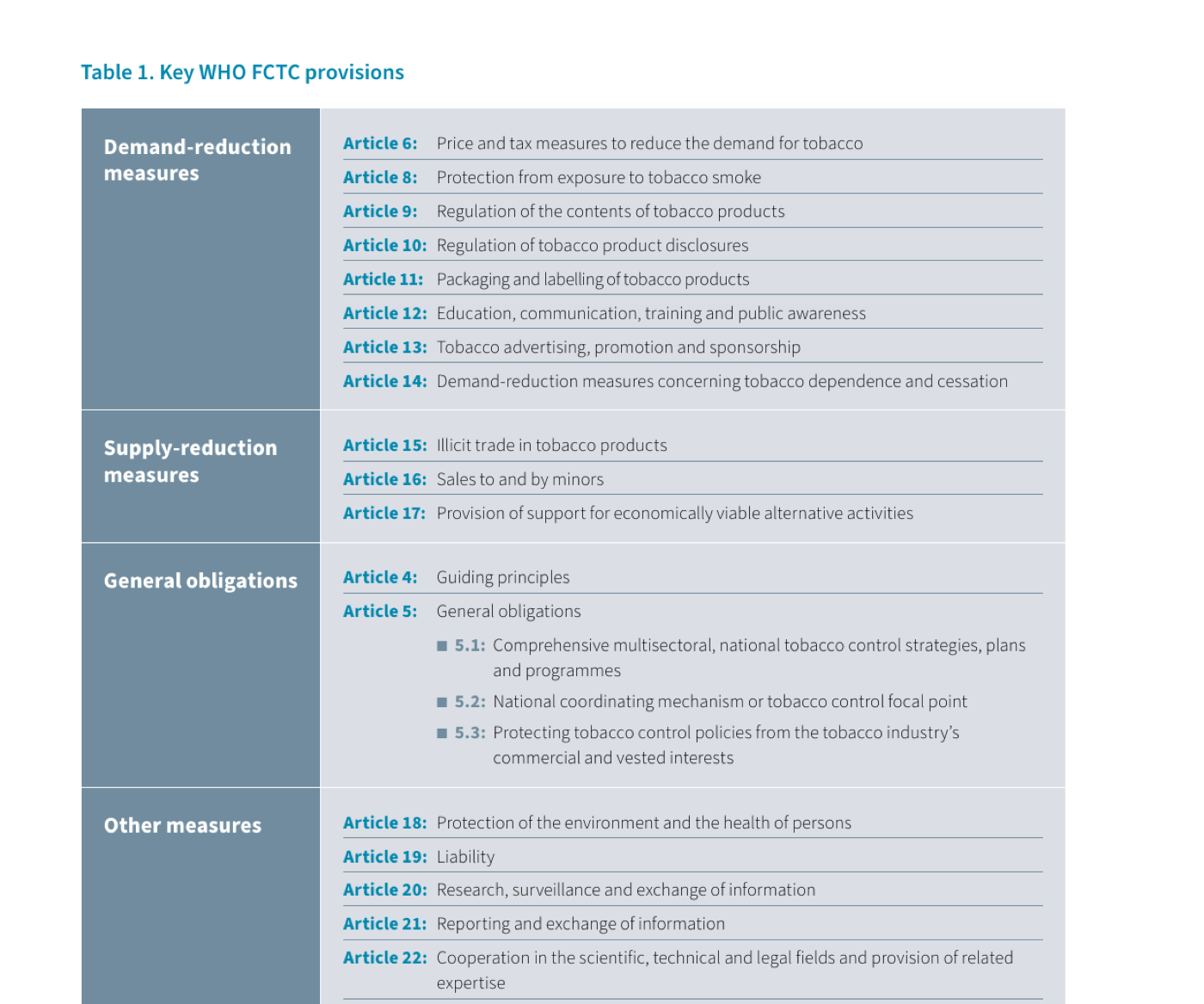
Table 1 (reproduced from Chapter 1): Key WHO FCTC provisions.
Saving lives for 20 years: The WHO FCTC
The Convention, which entered into force on 27 February 2005, has been supporting cessation, preventing initiation and saving lives for 20 years. It is among the most embraced United Nations treaties in history and is a pathfinding global health initiative — that was, before April 2025 and the agreement on the Pandemic Accord, the first and only dedicated public health treaty binding at international law. The WHO FCTC’s central role in global health and development is reflected in its inclusion in the Sustainable Development Goals (SDGs), specifically target 3.a, which urges countries to strengthen the implementation of the WHO FCTC, because of its critical role in reducing the burden of noncommunicable diseases.
“Over the past two decades, since the entry into force of the WHO FCTC and the MPOWER technical package that supports it, global tobacco use prevalence has dropped by one third. The WHO FCTC has helped to save millions of lives through strengthened tobacco control measures around the world. The Convention marks a milestone in public health and international law.”
— Dr Tedros Adhanom Ghebreyesus, WHO Director-General
Since the Convention entered into force, tobacco use is estimated to have declined by one third globally. The implementation of the WHO FCTC has helped drive these reductions. An impact assessment completed after 12 years of implementation showed that while significant gains in tobacco control have been achieved, great variability across countries and policy areas existed, and that higher WHO FCTC implementation levels were correlated with greater reductions in smoking prevalence. A more recent analysis by Paraje and colleagues of the impact of the WHO FCTC in the first 10 years following its entry into force shows notable positive impacts. The treaty is associated with a decrease in the rate of smoking for those younger than 25 years — with 24 million fewer people in this age group smoking — and an increase in the quitting ratio, with 2 million more people between ages 45 and 59 quitting smoking. At least 12 million deaths are estimated to have been averted in just one decade of the WHO FCTC’s implementation.
The twentieth anniversary was marked by the tobacco control community on 27 February 2025 at the WHO headquarters in Geneva. This was a moment to mark the historic achievement that the WHO FCTC’s entry into force represents and the indispensable contribution that 20 years of its implementation has made to global public health. It was also a moment to take stock of the barriers encountered to progress in the Convention’s implementation and threats posed to the WHO FCTC, and to consider strategies for overcoming these barriers and defending against these threats. Speakers highlighted the need to maximise the implementation of the WHO FCTC and counter the ongoing efforts of the tobacco industry to interfere with public health, undermine implementation and attract its next generation of customers — including youth, undersaturated markets in the Global South and vulnerable groups.
“The WHO FCTC equips Parties with a comprehensive set of measures to protect populations from the industry’s ever-evolving tactics — designed to profit at the cost of people’s lives and the health of our planet and we call on Parties to remain ever watchful against its predatory tactics.”
— Dr Tedros Adhanom Ghebreyesus, WHO Director-General
Update on COP10 and MOP3
In February 2024, the Tenth session of the Conference of the Parties to the WHO FCTC (COP10) and the Third session of the Meeting of the Parties to the Protocol (MOP3) were held in Panama. The COP and MOP are the governing bodies for, respectively, the WHO FCTC and the Protocol. These are the sole bodies for authoritative interpretations of their respective treaties with responsibilities for reviewing and guiding their implementation, adopting measures in response to emerging issues, and fostering international cooperation.
COP10 and MOP3 each adopted a Panama Declaration affirming the right to health, noting concern at tobacco industry interference, calling for strengthened implementation and the prioritisation of public health over industry interests, and emphasising the need for international cooperation.
At COP10, the Parties decided to establish an Expert Group on Forward-looking Tobacco Control Measures with a mandate for identifying and describing forward-looking measures — including measures that expand or intensify approaches to tobacco control. The foundation for this Decision was the uneven progress in implementation and the fact that some Parties have been advancing forward-looking tobacco control measures, together with the changing landscape of the tobacco epidemic and the ever-evolving tactics of the tobacco industry.
Other notable decisions include those on the implementation of Articles 18 and 19, which separately concern protection of the environment and tobacco industry liability. The Decision on Article 18 recognised the importance of linking environmental protection with tobacco industry liability under Article 19, and the promotion of economically sustainable alternatives to tobacco growing under Article 17. The Decision on Article 19 re-established an expert group on liability and mandated the expert group to review the practices of Parties in their implementation of the provision and to provide options for progressing implementation.
Another notable decision was the adoption of the Specific guidelines to address cross-border tobacco advertising, promotion and sponsorship and the depiction of tobacco in entertainment media for implementation of Article 13. The Parties also decided to improve the reporting system of the WHO FCTC, including by synergising the reports provided by Parties to the WHO FCTC on progress in the implementation of the Convention with the inputs on tobacco control policy and implementation provided by WHO Member States as part of the preparation of the biannual WHO reports on the global tobacco epidemic.
At MOP3, the Parties decided to improve the reporting system of the Protocol and to maintain the operation and use of the global information-sharing focal point. The Parties also decided to adopt a road map for conducting evidence-based research on the extent of illicit trade in tobacco products linked to duty-free sales and on key inputs essential to tobacco product manufacturing that can be controlled.
WHO FCTC and Protocol progress reports
In line with the Global Strategy to Accelerate Tobacco Control (which the COP has authorised to run until 2030), as well as Article 21 of the WHO FCTC and Article 32 of the Protocol, the Convention Secretariat produces a biennial progress report on implementation for each treaty that provides an overview of the status of the implementation of the Convention and the Protocol.
The latest Global Progress Report on Implementation of the WHO FCTC was released in November 2023 and shows that while progress has been made on almost all Articles, the level and pace of implementation still falls short of what is called for in the Global Strategy. Article 11 continues to be the most comprehensively implemented article, followed by Article 5. Article 13 remains the least implemented of the WHO FCTC articles identified as priorities in the Global Strategy. Across Parties, the main implementation barriers identified were tobacco industry interference and insufficient financial and human resources.
The 2023 Global Progress Report on Implementation of the Protocol to Eliminate Illicit Trade in Tobacco Products provides the second ever overview of progress made by Parties and, therefore, the first in which implementation trends can be discerned. Strong progress was reported on prosecutions and sanctions, security and preventative measures, and liability. Over half of the Parties reported progress in the establishment of tracking and tracing measures — an increase from the 2021 report. At the same time, relatively low levels of implementation were reported on information sharing and assistance and cooperation — though results still indicated an improvement over previous levels, with reported rates of implementation for each measure doubling. The main barriers for implementation of the Protocol as reported by Parties were resource constraints, technical and capacity limitations, and a lack of comprehensive legislation, strategies and domestic cooperation.
Highlights for COP11 and MOP4
The Parties to the two treaties will meet again in 2025 to guide and maintain momentum on implementing the WHO FCTC and the Protocol. The upcoming COP11 will take place in Geneva in November 2025 under the theme “Healthy planet, healthy future: uniting for tobacco-free generations” — which reflects the extent to which success in tobacco control hinges on strengthening a focus on youth engagement for preventing initiation, and environmental protection for progress on the full scope of the tobacco challenge. COP11 will also centre on a strategic dialogue and the 20-year anniversary of the WHO FCTC’s entry into force, with a reflection on progress, an emphasis on maintaining momentum and discussion of challenges and opportunities.
The theme for MOP4 is “Justice and prosecution: strengthening action to eliminate illicit trade in tobacco products” — emphasising the importance of enforcement and enforcement provisions for making the other mechanisms of the Protocol meaningful and effective.
Areas of focus at COP11 include further decisions on liability and forward-looking tobacco control measures as the Expert Groups on each topic established at COP10 report back. These decisions will inform and shape efforts to accelerate the WHO FCTC’s implementation, hold the tobacco industry to account and meet the challenge of the tobacco industry’s evolving strategies and tactics. In line with the theme and extending the discussion in COP10, the protection of the environment and the health of persons will also feature. Finally, tobacco product regulation and disclosure is set to be highlighted with an agenda item on Articles 9 and 10 — under-implemented measures that will benefit from a focused discussion at COP11.
The main areas of focus anticipated for MOP4 include follow-up from MOP3 on the topics of evidence-based research and the global information-sharing focal point, as well as the strategy for mechanisms of assistance and mobilisation of financial resources to support implementation.
WHO FCTC and measures to warn about the dangers of tobacco
Overview of Articles 11 and 12
The focus of this report — warning about the dangers of tobacco — aligns with Articles 11 and 12 of the WHO FCTC. Article 11 requires Parties to ensure the packaging and labelling of tobacco products contain health warnings and do not carry misleading information. Article 12 obliges Parties to promote and strengthen awareness on health risks of tobacco consumption and exposure, the adverse environmental and economic consequences of tobacco consumption and production, the benefits of not using tobacco and tobacco use cessation, and the tactics of the tobacco industry. These Articles are brought together under “W” in the MPOWER technical package because they each seek to strengthen awareness of the dangers of tobacco and counter tobacco industry misinformation. COP decisions to date aim to provide guidance and support for Parties in implementing Articles 11 and 12 and achieving their objectives.
As noted above, in the 2023 Global progress report on implementation of the WHO FCTC, Article 11 was found to be highly implemented, while a positive trend was observed for the implementation of Article 12 with high, increasing and sustained levels of reported implementation. For Article 11, the least well-implemented components of the Article were reported to be warnings that take up more than 50% of the principal display areas of packaging and the use of pictorial warnings, although both aspects saw progress when compared with 2021. At the same time, since both Articles fall within the mandate of Ministries of Health and are often susceptible to implementation by decree or other executive decision, these Articles should be implemented comprehensively and to a high level by all Parties. Sustained effort and renewal of these measures are needed to ensure the continued effectiveness of warnings over time and to suit changes in target populations.
Retrospective of COP decisions pertaining to “W”
The Guidelines for implementation of Article 11 and the Guidelines for implementation of Article 12 together provide a comprehensive evidence-based framework for the design and implementation of measures to warn about the dangers of tobacco while countering tobacco industry misinformation. The Guidelines for Articles 11 and 12 were adopted by the Parties to the WHO FCTC in, respectively, 2010 at COP3 and 2012 at COP4. The Guidelines for Article 11 include details on the design, location, size, rotation and contextual reinforcers for warnings on packaging, including the need to prevent packaging and labelling that is misleading, and the advantages of plain packaging for this purpose and reinforcing warnings. The Guidelines for Article 12 are rooted in research-based evidence and best practices and experience gained by Parties, and detail the way to reach diverse populations, the channels through which they can be reached and the need to include a focus on tobacco industry tactics within warnings. Together they guide the way forward for warning people about the dangers of tobacco — going beyond the simple conveyance of information to dismantle tobacco industry misinformation, denormalise tobacco use and highlight the broader costs of tobacco to people and planet.
Overview of related articles
Articles 11 and 12 are underpinned by the Article 4 principle that every person be informed of the health consequences, addictive nature and mortal threat posed by tobacco consumption and exposure. In their emphasis on information, these Articles also connect with Article 10 on tobacco product disclosures. Importantly, the warnings and information that Articles 11 and 12 require do not undermine the tobacco industry’s liability under Article 19, which encourages Parties to pursue civil and criminal accountability for the harm it causes, including compensation, amid its ongoing efforts to undermine implementation of the WHO FCTC and target populations through various other means.
In terms of countering industry misinformation and highlighting tobacco industry tactics, these two Articles also dovetail with Article 5.3 on tobacco industry interference and Article 13 on ending tobacco advertising, promotion and sponsorship — as well as the Guidelines for implementation for each of these Articles. Strong connections also exist between Articles 11 and 12 and Article 14 on tobacco cessation, which is underpinned by information and awareness of the facts on tobacco. Public awareness of tobacco’s dangers and of the purposes of public health measures addressing these dangers has also been shown to act as a multiplier for the impact of other stand-alone interventions, including maximising the behavioural shift induced by tobacco taxation-related price increases (Article 6) and strengthening compliance with and acceptability of restrictions on tobacco exposure (Article 8). Finally, a globally comprehensive and accelerated implementation of Articles 11 and 12 depends on cooperation under Articles 20 and 22, particularly in sharing research and transferring technical, scientific and legal expertise and technology. This cooperation is particularly important for smaller countries, where the cost of developing effective warnings is relatively high, and which therefore could benefit from building on, learning from and adapting health warnings and mass media campaigns developed elsewhere.
Decisions and reports relating to heated tobacco products (HTPs)
HTPs are tobacco products that produce aerosols containing nicotine and other chemicals by heating tobacco units. In 2018, the COP at its Eighth session recognised that HTPs are tobacco products and are therefore subject to the provisions of the WHO FCTC. Since their emergence, HTPs have been marketed by the tobacco industry with health and cessation claims that are not supported by independent, robust evidence. One main claim the tobacco industry makes is that HTPs do not combust tobacco or produce smoke and that this makes them “reduced-risk” products.
At COP8, the Parties recognised that these claims and the properties of HTPs “may pose regulatory challenges regarding their definition and classification […] and that these may pose challenges for the comprehensive application of the WHO FCTC”. In the Decision, Parties noted the particular challenge for preventing health claims and other misleading marketing with respect to these products and requested that all Parties prioritise specific measures, including preventing health claims being made and regulating or restricting the presentation of these products taking into account a high level of protection for human health.
In response to the issues around classifying the emissions of HTPs, the Convention Secretariat and WHO were requested to examine and report back at COP9 on the claims of reduced harm, their perception and use, attractiveness and related challenges for the application of the WHO FCTC. The resulting report addressed challenges in implementing Article 11 with respect to cooperating on developing and sharing health warnings that can address the specificities of these products and adapting and applying regulations and laws on health warnings and plain or standardised packaging to the devices themselves, which can be sold separately from the tobacco inserts. This report also made clear that any smoke emitted by HTPs is unambiguously “tobacco smoke” — a clarification that has important implications for HTPs, since it clarifies the need to classify, regulate and require warnings for them to the same standard as other tobacco products, including smoked tobacco products.
Decisions and reports relating to ENDS and electronic non-nicotine delivery systems (ENNDS)
ENDS and ENNDS do not necessarily contain tobacco, and instead heat a solution to create an aerosol that users inhale — a solution composed of numerous compounds, which include nicotine in the case of ENDS, or may not contain nicotine in the case of ENNDS. Their emissions do include toxicants and exposure to them poses risks to non-users.
At its Sixth session, the COP outlined the key objectives to be pursued in addressing ENDS/ENNDS: preventing initiation by non-smokers and youth; preventing unproven health claims being made about ENDS/ENNDS; minimising harms to users and protecting non-users from exposures to emissions; and protecting tobacco control in relation to ENDS/ENNDS from commercial influence and interference. At the Seventh session of the COP, Parties were also invited to apply regulatory measures to prohibit or restrict the manufacture, import, distribution, presentation, sale and use of ENDS/ENNDS as appropriate. Parties that have not totally banned those products were invited to follow a non-exhaustive list of regulatory options for pursuing the objectives set out in the COP6 Decision (provided in a report prepared by WHO) that were endorsed for consideration by the Parties. The recommendation was that the Parties apply certain regulatory measures found in the provisions of the WHO FCTC to ENDS/ENNDS, including regulating their labelling, prohibiting unproven health claims and requiring health warnings about their risks and the addictive nature of nicotine, in line with Article 11.
The power of Articles 11 and 12 for warning about the dangers of tobacco
Articles 11 and 12 of the WHO FCTC are a critical element of global tobacco control efforts, corresponding to “MPOWER measure W” — warning about the dangers of tobacco — the focus of the WHO report on the global tobacco epidemic, 2025. By raising awareness of tobacco’s harms and countering tobacco industry misinformation, these Articles are a vital underpinning to and enabler of all other tobacco control measures. To be fully effective, these warnings must be mandated and enforced across all tobacco products and designed to reach and be salient to all populations, particularly young people and those in vulnerable groups, and be implemented as part of a comprehensive package alongside other complementary measures (such as Article 13 in the WHO FCTC that corresponds to the “E” MPOWER measure — enforcing bans on tobacco advertising, promotion and sponsorship). In designing and implementing measures to warn people about the dangers of tobacco, the WHO FCTC and related COP decisions and guidelines provide a crucial resource and support.
The third WHO report on the global tobacco epidemic, in 2011, also focused on “W”, reflecting the importance of the measure for saving and improving lives as well as how feasible and acceptable it is for implementation. However, despite this prominence under both MPOWER and the COP’s own agenda, various challenges have emerged in implementing Articles 11 and 12, including lack of political will and resources to move to plain packaging and adopt large pictorial health warnings and to sustain both packaging and mass media warnings with rotating and periodically refreshed images and through new and carefully designed campaigns.
Twenty years after the WHO FCTC’s entry into force, the “W” measures under Articles 11 and 12 should be protecting all people in all countries. The remaining adoption and implementation gaps are unacceptable and can be overcome. The barriers to progress are relatively surmountable: these measures have been identified as highly cost-effective noncommunicable disease best buys and fall within the existing mandates of most Ministries of Health, making them among the most readily implementable WHO FCTC articles. With urgent action that builds on research and implementation experience, we can ensure all people are protected by high-quality tobacco warnings far earlier than in 20 more years — but only if we act decisively now.