Chapter on WHO FCTC and Illicit Trade Protocol
This chapter underscores the importance of legally binding international treaties as crucial linchpins in global tobacco control efforts. Dr Bettcher and Juliette chart global progress, outline global challenges and discuss future directions for their implementation. After this, they focus in on Article 8 of the WHO FCTC, which mandates action to protect people from exposure to tobacco smoke. This corresponds with the “P” in the MPOWER technical package — “protect from tobacco smoke” — and is needed to shield all people from the harmful effects of tobacco smoke. They show that, despite progress, implementation of both Article 8 and of “P” remains insufficient.
Introduction to the WHO FCTC and Protocol
The WHO Framework Convention on Tobacco Control (WHO FCTC) and the Protocol to Eliminate Illicit Trade in Tobacco Products are evidence-based, legally binding international instruments. With 182 and 67 Parties respectively as at June 2023, these treaties are unifying frameworks for intergovernmental cooperation and are fundamental to combatting the global tobacco epidemic and upholding the right of all people to the highest attainable standard of health.
Since its entry into force on 27 February 2005, the WHO FCTC has included a core set of mutually reinforcing obligations to reduce the demand for, and supply of, tobacco products. Those are supported by an equally important set of general obligations for advancing progress and cooperation on tobacco control locally, nationally, regionally and globally. Of these, Article 5.3 and its Guidelines for implementation provide crucial safeguards against tobacco industry influence over, and interference in, tobacco control policies. The general obligations are reinforced by other measures such as Article 19 on liability, which innovatively targets the industry’s deceptive, profit-driven tactics.
The Protocol, which entered into force on 25 September 2018, focuses on eliminating illicit trade in tobacco products. It was developed to build on Article 15 of the Convention in recognition of the complexity of addressing illicit trade, its significant contribution to the global tobacco epidemic, and the threat it poses to key demand-reduction measures — especially price measures and health warnings. The Protocol provides a framework for international cooperation, including on global tracking and tracing, and prescribes a comprehensive set of measures, such as supply-chain control and due diligence obligations, to combat the illicit tobacco market.
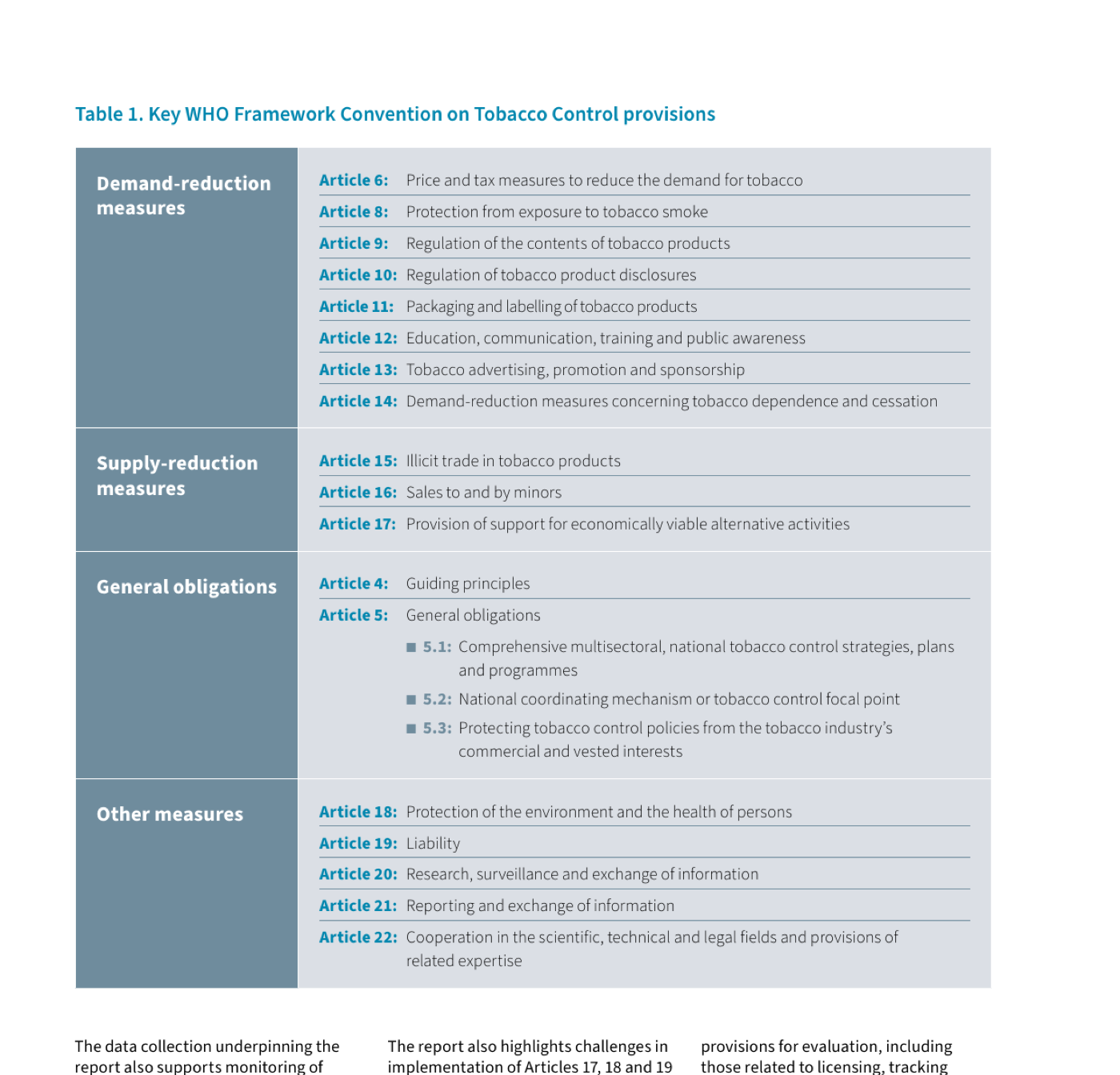
Table 1 (reproduced from Chapter 1): Key WHO Framework Convention on Tobacco Control provisions.
Update on COP9 and MOP2
In November 2021, the Ninth Session of the Conference of the Parties to the WHO FCTC (COP9) and the Second Session of the Meeting of the Parties to the Protocol (MOP2) were held. A major outcome was the Declaration on the WHO FCTC and recovery from the Coronavirus disease (COVID-19) pandemic, which called for measures to prevent tobacco industry efforts to exploit the public health emergency as a means of furthering its own interests and undermining tobacco control measures. It emphasised the deadly interplay between tobacco use and COVID-19 — with the former having exacerbated both COVID-19 risk and severity during the pandemic, which in turn increased health system vulnerability. It also emphasised the importance of fully implementing the WHO FCTC as a means of addressing the vulnerabilities which underlay the crisis, achieving the Sustainable Development Goals (SDGs) and overcoming the devastation caused by the pandemic.
At MOP2, Parties adopted the Decision on assistance and cooperation, which reinforced the indispensability of mutual assistance and international cooperation in enforcement, investigation and prosecution, and also in administrative, legislative and scientific domains for the achievement of the Protocol’s objectives. In particular, it mandated the Convention Secretariat to facilitate cooperation between Parties and offer technical assistance to Parties implementing the Protocol. It also highlighted the need for Parties and the Convention Secretariat to collectively establish mechanisms and procedures for sharing experiences, best practices and other information on the implementation of the Protocol.
At both COP9 and MOP2, the Parties adopted decisions for establishing the WHO FCTC Investment Fund and the Protocol Investment Fund. These new financing mechanisms will provide sustainable funding for the implementation of the WHO FCTC and the Protocol in alignment with COP and MOP decisions, workplans and budgets.
WHO FCTC progress report
WHO FCTC implementation is aligned with the COP-adopted Global Strategy to Accelerate Tobacco Control (Global Strategy 2025) and contributes to the achievement of the SDGs. SDG Target 3.a calls for the strengthening of the implementation of the WHO FCTC in all countries to reduce tobacco use and its related health, social and economic impacts. In line with the strategy, as well as Article 21 of the WHO FCTC and Article 32 of the Protocol, the Convention Secretariat produces a biennial progress report on implementation for each treaty — the Global progress report on implementation of the WHO FCTC — which provides an overview of the status of the Convention’s implementation.
The data collection underpinning the report also supports monitoring of progress on the indicators set out in the Global Strategy 2025. By disaggregating progress on each of the core articles of the WHO FCTC (5, 6, 8, 11 and 13) into various indicators, the report illustrates the comprehensiveness of progress made by the Parties. The latest report (2021) shows that while implementation rates of individual measures are high, many measures are not implemented in full. Parties report that Articles 5 and 11 are the most advanced, while Article 13 is the least advanced. The report also highlights challenges in implementation of Articles 17, 18 and 19 on economically viable alternatives to tobacco, environmental protection, and industry liability.
Protocol progress report
The 2021 Global progress report on implementation of the Protocol to Eliminate Illicit Trade in Tobacco Products was the first of its kind and provides an overview of progress made by Parties. It also focuses in on key provisions for evaluation, including those related to licensing, tracking and tracing, law enforcement, and international cooperation. It notes that most Parties remain at early-stage implementation, with progress very uneven among the various Parties and elements of individual articles. With respect to establishing tracking and tracing systems, almost half of respondent Parties confirmed some level of implementation. The greatest level of progress was found in measures relating to licensing and control, proscribing unlawful conduct and establishing prosecution and sanctions. The most underreported measure was international cooperation — which matters because the key barriers to progress reported by Parties, such as insufficient technical capacities and financial resources, could be addressed through improved international cooperation.
Highlights for COP10 and MOP3
To guide and maintain momentum on implementing the WHO FCTC and the Protocol, the upcoming COP10 will take place in Panama in November 2023 under the theme “Together, promoting healthier lives”, reflecting the extent to which success in tobacco control hinges on partnership and cooperation across the whole of society, government and the world. The theme for MOP3 is “More Parties, greater traceability, less illicit trade” — emphasising the significance of rising numbers of Parties to the Protocol and the establishment of a global tracking and tracing regime, and the need for the Protocol’s reach to be expanded further.
Key areas of focus at COP10 include tobacco product regulation, forward-looking tobacco control measures in relation to Article 2.1 of the WHO FCTC, and implementation of Article 19. These and all discussions at the meeting will be guided and informed by the Global Strategy 2025 as well as the findings of the recent WHO FCTC progress report.
Tobacco product regulation to be a COP10 highlight
Tobacco product regulation is set to be a highlight, with an emphasis on developing and implementing evidence-based measures to reduce the appeal, addictiveness and toxicity of tobacco products — in line with Articles 9 and 10 as well as the Partial Guidelines for implementation of Articles 9 and 10. As set out in the recent progress report, these two are among the least implemented of the WHO FCTC’s substantive articles, despite evidence of encouraging progress on key measures for each article. Accordingly, this focus will provide an opportunity to bridge the implementation gap.
COP10 is also scheduled to address forward-looking tobacco control measures in relation to Article 2.1 of the WHO FCTC, which stipulates Parties are not confined to the provisions of the Convention and are thus not prevented from imposing stricter requirements than those it contains. This encourages and empowers Parties to implement novel measures to accelerate progress in tobacco control — such as tobacco-free generation policies, which aim to prevent entire generations from ever initiating tobacco use, and other end-game approaches for eliminating tobacco consumption altogether using strategies for de-nicotinisation and policies for restrictions on retail availability.
COP10 to raise tobacco industry accountability
It is also anticipated that COP10 will grapple with measures that require tobacco industry accountability for the impact of their products — in line with Article 19. Industry accountability encompasses past, present and future loss of life, detriment to health, loss of productivity, health care expenses, health system fragility, exacerbation of the COVID-19 pandemic, occupational health hazards and environmental damage.
Finally, the COP’s agenda is likely to feature items on the tobacco industry’s new strategies for evading and undermining tobacco control. Such strategies include novel and redesigned tobacco and nicotine products, and marketing tactics and misinformation campaigns to circumvent regulations, maintain existing customers, and extend reach to younger generations. The ever-evolving nature of tobacco industry tactics will make COP10 oversight over these strategies invaluable.
WHO FCTC and measures to protect people from tobacco smoke
Overview of Article 8 and related articles
The focus of this report — implementing smoke-free environments — aligns with Article 8 of the WHO FCTC, which mandates Parties to adopt and implement effective legislative, executive and administrative measures to protect people from exposure to tobacco smoke. COP decisions to date aim to provide guidance and support for Parties in implementing Article 8 and achieving its objectives. In the 2021 Global progress report, the majority of Parties reported some level of implementation of Article 8 provisions, but they reported a much lower rate of implementation when it came to comprehensive implementation of all key measures under Article 8 — showing considerable room for progress.
Retrospective of COP decisions pertaining to “P”
Since the adoption of the WHO FCTC, several decisions have been taken by the COP in relation to Article 8 and the protection of people from exposure to tobacco smoke. The importance of this Article and the high priority it has been accorded is reflected in how — at the first meeting of the COP — the Parties approved templates for the elaboration of guidelines for the implementation of Article 8 and requested the Convention Secretariat to initiate work on these guidelines. Consequently, the Guidelines for implementation of Article 8 were the first adopted by the COP (at only its second meeting) for any WHO FCTC article.
The Guidelines provide a comprehensive framework for the design and implementation of measures to universally protect people from exposure to tobacco smoke. They emphasise the importance of adopting a comprehensive approach — including the establishment of 100% smoke-free environments, public education and awareness-raising campaigns, and monitoring and enforcement mechanisms. They make explicit that the language of Article 8 provides for further evidence-informed measures that extend protections to settings beyond those in its non-exhaustive list.
The Guidelines for implementation of Article 8, alongside the content of other guidelines, make clear the necessity of Article 8’s comprehensive implementation alongside other interdependent WHO FCTC articles. In particular, package and labelling warnings (Article 11) and awareness-raising (Article 12) shift behavioural norms to reinforce the effectiveness of regulation in protecting people from exposure to tobacco smoke, while going further to protect people in private spaces who are outside the realm of even the most comprehensive regulatory approaches. This is important because exposure to tobacco smoke occurs most in private settings, such as homes, with a disproportionate impact on women and children. Progress with any of these articles also enables advances in other articles, since they generally fall within the jurisdiction of ministries of health and are implementable by decree or other executive decision. Both their substantive and procedural interconnection emphasise the need for a comprehensive approach, integrating smoke-free environments with health warnings and labelling regulations, as well as public awareness raising, to strengthen the overall impact of tobacco control measures.
Decisions relating to heated tobacco products (HTPs)
HTPs are tobacco products that produce aerosols containing nicotine and other chemicals by heating tobacco units. In 2018, COP8 recognised that HTPs “are tobacco products and are therefore subject to the provisions of the WHO FCTC”. Since their emergence, HTPs have been marketed by the tobacco industry with health and cessation claims that are not supported by independent, robust evidence. One main health claim is that they do not combust tobacco or produce smoke and that this makes them “reduced risk” products. At COP8, the Parties recognised that these claims and the properties of HTPs “may pose regulatory challenges regarding their definition and classification … and that these may pose challenges for the comprehensive application of the WHO FCTC”. In the Decision, Parties noted the particular challenge for smoke-free legislation and requested that all Parties prioritise particular measures, including protecting “people from exposure to their emissions” and explicitly extending “the scope of smoke-free legislation to these products in accordance with Article 8 of the WHO FCTC”.
In response to the issues around classifying the emissions of HTPs, the Convention Secretariat and WHO were requested to examine and report back at COP9 on the health impacts of HTP emissions for non-users and related challenges for the application of the parts of the WHO FCTC and its guidelines that refer to tobacco smoke. The resulting report concluded that the aerosols commonly emitted by HTPs do fall under the definition of tobacco smoke. It was further detailed that the evidence shows that non-users are exposed to toxicants from HTP emissions.
Decisions relating to ENDS
ENDS and electronic non-nicotine delivery systems (ENNDS) do not necessarily contain tobacco and instead vaporise a solution composed of numerous compounds, which include nicotine in the case of ENDS, or may not contain nicotine in the case of ENNDS. Their emissions do include toxicants, and exposure to them poses risks to non-users. COP6 set out the basic objectives to be pursued in addressing ENDS/ENNDS including the protection of non-users from exposure to their emissions. At COP7, Parties were also invited to apply regulatory measures to prohibit or restrict the manufacture, import, distribution, presentation, sale and use of ENDS/ENNDS, as appropriate. Parties that have not totally banned those products were invited to follow a non-exhaustive list of regulatory options for pursuing the objectives set out in the COP6 decision — provided in a report prepared by WHO — that were endorsed for consideration by the Parties. Such regulation entails the application of many of the WHO FCTC’s measures for ENDS/ENNDS, prominently including minimising exposure to emissions by prohibiting their use in indoor spaces and other places where smoking is not permitted and requiring health warnings about their risks — in line with Articles 8 and 11.
The growing power of Article 8 to protect from tobacco
Article 8 of the WHO FCTC is a critical element of global tobacco control efforts that protect our right to health and is the focus of the WHO report on the global tobacco epidemic, 2023. It corresponds to “MPOWER measure P” — “protect from tobacco smoke” — and extends protection to many of the most vulnerable groups in society. To be fully effective, these protections need to be mandated and enforced across a wide range of settings and need to be implemented as part of a comprehensive package alongside other complementary measures (such as Articles 11 and 12 in the WHO FCTC that correspond to the “W” MPOWER measure — “warn about the dangers of tobacco”). In designing and implementing measures to protect people from tobacco smoke, the WHO FCTC and related COP decisions and guidelines provide a crucial resource and support.
The second WHO Report on the global tobacco epidemic, in 2009, also had “P” as its focus. This reflects the importance of the measure for saving and improving lives as well as how feasible and acceptable it is for implementation. However, despite this prominence under both MPOWER and the COP’s own agenda, various challenges and successes have emerged in implementing Article 8, including lack of political will and resources to move beyond superficial measures and ensure comprehensive enforcement. Recent data, however, show the considerable benefits of implementing MPOWER measures and the demand-reduction provisions of the WHO FCTC, including Article 8, with a rate of return of US$ 7.11 for every dollar invested. This emphasises the importance of sustained commitment, investment and support from Member States and Parties in, respectively, using the MPOWER package and in advancing the Convention’s implementation.
Urgent need to do more with Article 8
As has been shown, despite significant progress since the WHO FCTC came into force 18 years ago and since MPOWER was established 15 years ago, implementation of Article 8 and of “P” remains insufficient in many countries, as shown by both this report and the 2021 progress report. There is, accordingly, an urgent need to seize the moment to make progress on this foundational measure. It is, out of all the WHO FCTC Articles, evidently among the most feasible to implement at a low cost across a variety of national settings. It is also among the Articles with the most expansive and rich evidence base to support both the benefits of smoke-free environments and the absence of negative effects. Urgent efforts are crucial to ensure the timely and successful implementation of Article 8 and other related WHO FCTC provisions.