Where the world stands on the '10-10-10' social enabler policies: mapping and analyzing progress and gaps
Introduction
Criminalisation, stigma and discrimination against people living with HIV, key populations, women and girls, and other marginalised populations create very real barriers to achieving global HIV/AIDS goals. Evidence shows that, in order to end AIDS by 2030, it is crucial that countries remove punitive laws that criminalise key populations and expand rights-supportive laws and policies that fight stigma, discrimination, gender-based violence and gender inequity (The Lancet HIV, 2021).
The HIV Policy Lab tracks seven laws and policies that countries should adopt to create a legal and policy environment conducive to achieving the UNAIDS-proposed ‘10-10-10’ societal enabler targets. No country in the world has adopted all seven. 181 countries have adopted at least one, and each of the seven has been adopted by at least one country.
This poster presents an analysis of policy co-occurrence to understand the extent to which countries across the WHO regions have adopted different policy combinations. Co-occurrence refers to how often a single country has adopted a pair of policies at the same time. This captures not just the frequency of each policy’s adoption, but also which policies travel together. For example, in the analysis below, same-sex relationship decriminalisation co-occurs frequently with national human rights institutions across all regions.
Methods
To represent the total value of policy adoption for the 10-10-10 targets, the societal enablers indicators of the HIV Policy Lab were totalled for 2020.
To understand how policies occur together, the indicators were extracted from the main HIV Policy Lab dataset and used to construct a co-occurrence matrix. Each pair of policies (k, l) is summed together and averaged over n rows (194 countries) in the dataset; that value is the co-occurrence value for the pair. The resulting matrix is rendered as a circular (chord) diagram: each node’s size is proportional to the total frequency of that policy in the dataset, and each edge’s thickness is proportional to the frequency of co-occurrence of the two policies it connects — the thicker and darker the edge, the more countries in which the two policies co-occur.
The seven policies analysed are:
- S1i — Same-sex non-criminalisation (laws)
- S1ii — Same-sex non-criminalisation (arrests)
- S2 — Sex work non-criminalisation
- S3 — Drug use non-criminalisation
- S4i — HIV exposure non-criminalisation (laws)
- S4ii — HIV exposure non-criminalisation (arrests)
- S5i — Non-discrimination protections — sexual orientation
- S5ii — Non-discrimination protections — gender identity
- S5iii — Non-discrimination protections — HIV status
- S6 — National human rights institutions
- S7 — Gender-based violence
Results
The analysis produces a co-occurrence chord diagram for each of the six WHO regions, allowing the shape of progress — and the gaps — to be compared across the regions at a glance.
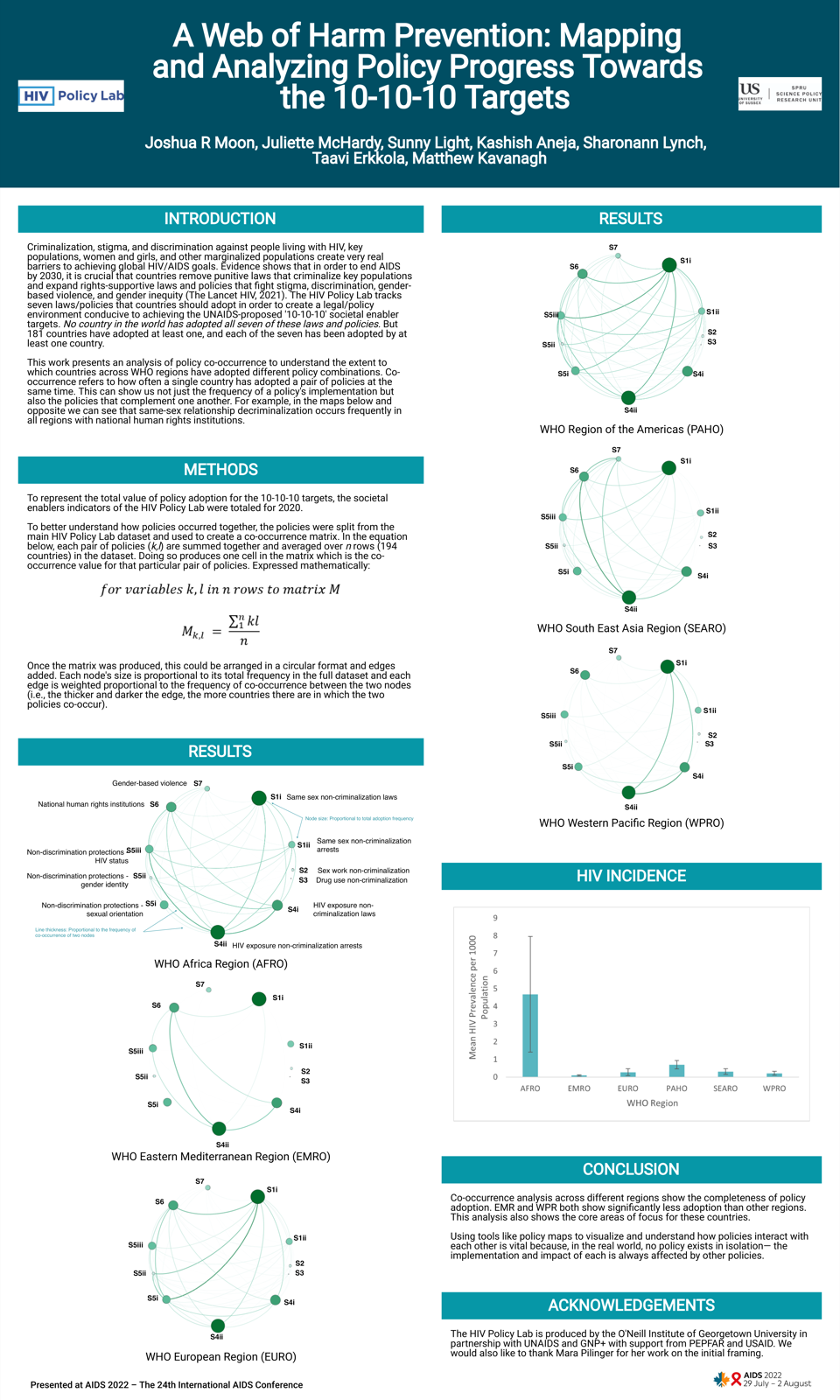
Poster (AIDS 2022): A Web of Harm Prevention — mapping and analysing policy progress toward the 10-10-10 targets, with co-occurrence chord diagrams for the WHO Region of the Americas (PAHO), WHO South-East Asia Region (SEARO), WHO Western Pacific Region (WPRO), WHO Africa Region (AFRO), WHO Eastern Mediterranean Region (EMRO) and WHO European Region (EURO).
Conclusion
The co-occurrence analysis across the regions highlights two main findings.
First, the completeness of policy adoption varies considerably between regions. The WHO Eastern Mediterranean and Western Pacific Regions both show significantly less adoption than other regions, and the shape of their diagrams exposes the absence of rights-supportive policies that tend to travel together elsewhere.
Second, the analysis reveals the core areas of focus in each region — the pairs and clusters of policies that countries have adopted together — and therefore the points of leverage on which further progress might be built.
Using tools like policy maps to visualise and understand how policies interact with each other is vital because, in the real world, no policy exists in isolation: the implementation and impact of each policy is always affected by the others around it.
Acknowledgements
The HIV Policy Lab is produced by the O’Neill Institute of Georgetown University in partnership with UNAIDS and GNP+, with support from PEPFAR and USAID. The authors also thank Mara Pilinger for her work on the initial framing.