Chapter on WHO FCTC and Illicit Trade Protocol
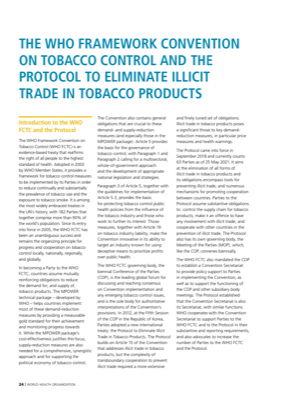
Introduction to the WHO FCTC and the Protocol
The WHO Framework Convention on Tobacco Control (WHO FCTC) is an evidence-based treaty that reaffirms the right of all people to the highest standard of health. Adopted in 2003 by WHO Member States, it provides a framework for tobacco control measures to be implemented by its Parties in order to reduce continually and substantially the prevalence of tobacco use and exposure to tobacco smoke. It is among the most widely embraced treaties in the UN’s history, with 182 Parties that together comprise more than 90% of the world’s population. Since its entry into force in 2005, the WHO FCTC has been an unambiguous success and remains the organising principle for progress and cooperation on tobacco control — locally, nationally, regionally and globally.
In becoming a Party to the WHO FCTC, countries assume mutually reinforcing obligations to reduce the demand for, and supply of, tobacco products. The MPOWER technical package — developed by WHO — helps countries implement most of the demand-reduction measures by providing a measurable gold standard for their achievement and monitoring progress towards it. While the MPOWER package’s cost-effectiveness justifies this focus, supply-reduction measures are also needed for a comprehensive, synergistic approach and to support the political economy of tobacco control.
The Convention also contains general obligations that are crucial to these demand- and supply-reduction measures. Article 5 provides the basis for the governance of tobacco control, with Paragraphs 1 and 2 calling for a multisectoral, whole-of-government approach and the development of appropriate national legislation and strategies. Paragraph 3 of Article 5, together with the guidelines for implementation, provides the basis for protecting tobacco control public-health policies from the influence of the tobacco industry and those working to further its interests. Those measures, together with Article 19 on tobacco industry liability, make the Convention innovative in its ability to target an industry known for using deceptive means to prioritise profits over public health.
The WHO FCTC governing body, the biennial Conference of the Parties (COP), is the leading global forum for discussing and reaching consensus on Convention implementation and any emerging tobacco control issues, and is the sole body for authoritative interpretation of the Convention’s provisions. In 2012, at the Fifth Session of the COP in the Republic of Korea, Parties adopted a new international treaty: the Protocol to Eliminate Illicit Trade in Tobacco Products. The Protocol builds on Article 15 of the Convention that addresses illicit trade in tobacco products, but the complexity of transboundary cooperation to prevent illicit trade required a more extensive and finely tuned set of obligations. Illicit trade poses a significant threat to key demand-reduction measures, in particular price measures and health warnings.
The Protocol came into force in September 2018 and, as of 25 May 2021, has 63 Parties. It aims at the elimination of all forms of illicit trade in tobacco products, and its obligations encompass tools for preventing illicit trade and numerous mechanisms for promoting cooperation between countries. Parties to the Protocol assume substantive obligations to: control the supply chain for tobacco products; make it an offence to have any involvement with illicit trade; and cooperate with other countries in the prevention of illicit trade. The Protocol has its own governing body, the Meeting of the Parties (MOP), which, like the COP, convenes biennially.
The WHO FCTC also mandated the COP to establish a Convention Secretariat to provide policy support to Parties and to support the functioning of the COP and other subsidiary-body meetings. The Protocol established that the Convention Secretariat is also its Secretariat, with similar functions. WHO cooperates with the Convention Secretariat to support Parties to the WHO FCTC and to the Protocol in meeting their substantive and reporting obligations, and also advocates to increase the number of Parties to both instruments.
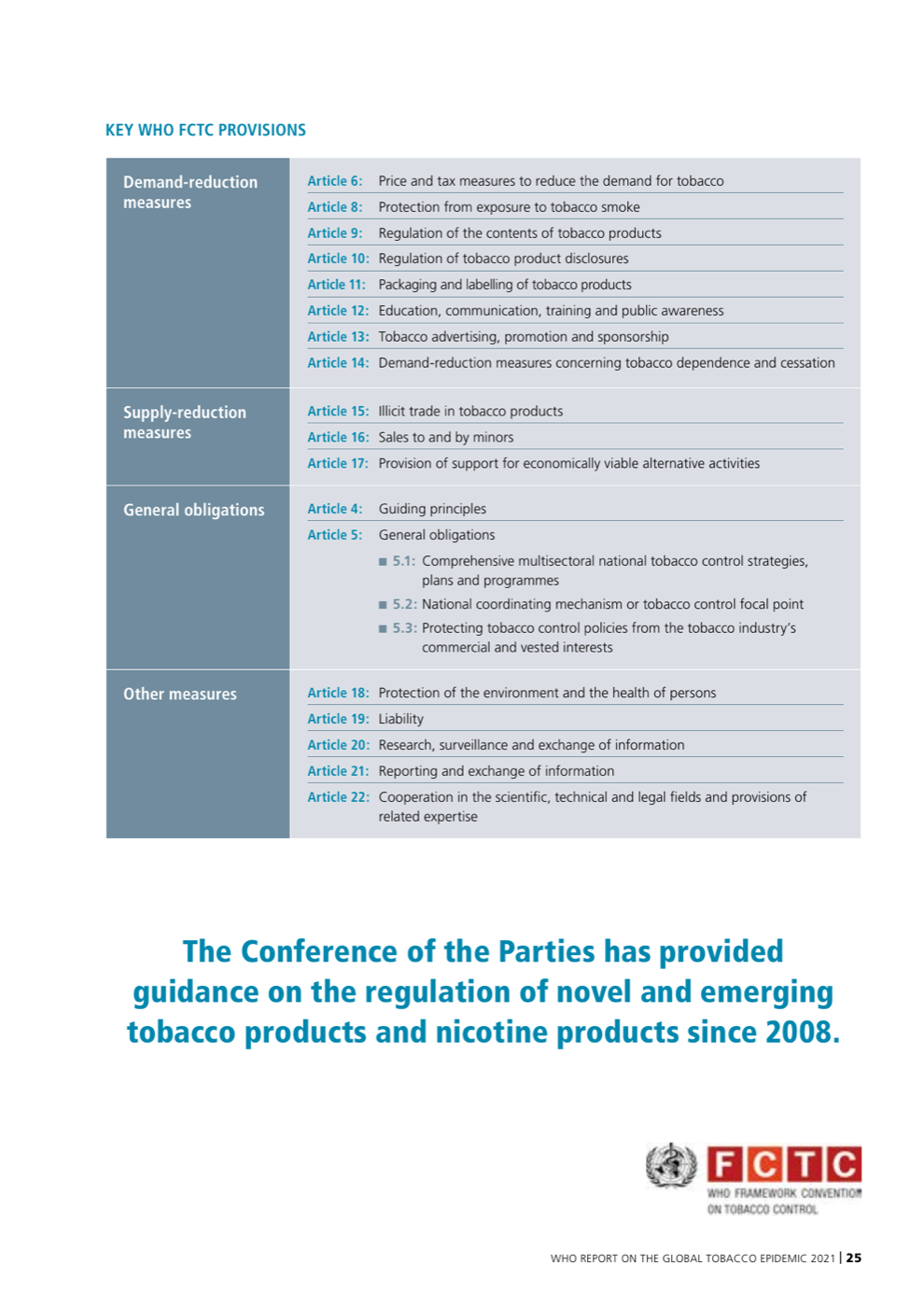
Key WHO FCTC provisions, grouped into demand-reduction measures, supply-reduction measures, general obligations and other measures.
COVID-19’s effect on WHO FCTC and Protocol implementation
The devastation caused by the COVID-19 pandemic starkly illustrates the need for accelerated implementation of the WHO FCTC and the Protocol, with a particular focus on scaling up achievement of the MPOWER technical package. There is irrefutable evidence of a deadly interplay between COVID-19 and tobacco use, both past and present: those infected with the virus who are tobacco users have suffered more severe disease progression than non-tobacco users; health-system vulnerabilities have been exacerbated; and tobacco use has increased the pandemic’s human and economic costs. Accordingly, global and national efforts to build back better will be incomplete unless the “tobacco pandemic”, alongside other vulnerabilities underlying the crisis, is addressed.
More broadly, the COVID-19 pandemic and the accompanying global economic recession have disrupted political agendas — in certain cases at the expense of activities such as tobacco control that may appear less pressing or uneconomical, challenging progress on implementation of the WHO FCTC and the Protocol. Most strikingly, the Ninth Session of the COP (COP9) and the Second Session of the MOP (MOP2), originally scheduled for November 2020, were postponed until November 2021.
The pandemic has also provided opportunities for advancing tobacco control measures. 17 countries in the Eastern Mediterranean Region have banned the use of waterpipes (shishas) in public places, and South Africa temporarily banned tobacco sales under a general ban on the sale of “non-essential” products during its pandemic response. Other countries, such as South Africa and the Russian Federation, have raised tobacco taxes in an effort to save lives while mobilising revenue to fight the pandemic and its associated economic crisis.
The tobacco industry has taken advantage of the situation by muddying the science on tobacco’s link with COVID-19 and positioning itself as an economic and development partner for national COVID-19 recovery efforts. Many of the major tobacco industry actors have — under the banner of so-called corporate social responsibility — used a small portion of their immense resources on heavily publicised COVID-19-related charity programmes. As the Guidelines for implementation of Article 13 of the WHO FCTC note, these activities are a form of sponsorship.
COP9 (8–13 November 2021) and MOP2 (15–18 November 2021)
The COVID-19 pandemic means that the forthcoming sessions of the COP and MOP will be held virtually. At the sessions, delegates will note implementation progress and identify challenges and opportunities for advancing and strengthening comprehensive implementation of both treaties. Parties will adopt new decisions to guide the future direction of implementation — inter alia, by establishing new subsidiary bodies, clarifying the interpretation of obligations, and requesting the Convention Secretariat and/or inviting WHO to undertake specific tasks and report on them.
After nearly two years of pandemic-related disruption to the tobacco control agenda, and despite an abridged Provisional Agenda, both COP9 and MOP2 will feature important items — such as a proposed investment fund for the WHO FCTC and the Protocol, an innovative financing mechanism that aims to provide much-needed resources for implementation of both treaties.
A highlight of the MOP2 Provisional Agenda is consideration of a report from a subsidiary body established by MOP1 on tracking and tracing systems for tobacco products. Under Article 8 of the Protocol, Parties agreed to establish a global tracking and tracing regime by September 2023. This global regime will comprise national and regional systems intended to ensure that Parties can secure the supply chain of tobacco products, and a global information-sharing focal point located at the Convention Secretariat that will enable Parties to exchange information in order to better tackle illicit trade. The MOP’s deliberation on this matter will be crucial for guiding and promoting timely implementation of this technically complex obligation.
Novel and emerging tobacco products and nicotine products
The COP has provided guidance on the regulation of novel and emerging tobacco products and nicotine products since 2008, with a particular focus on heated tobacco products (HTPs), electronic nicotine delivery systems (ENDS) and electronic non-nicotine delivery systems (ENNDS). The COP has defined the landscape as follows. HTPs are tobacco products, which produce aerosols containing nicotine and other chemicals by heating tobacco units; they are subject to the provisions of the WHO FCTC. By contrast, ENDS and ENNDS do not contain tobacco and instead vaporise a solution composed of numerous compounds, which include nicotine in the case of ENDS, or may not contain nicotine in the case of ENNDS.
In relation to ENDS/ENNDS, COP6 invited Parties “to consider prohibiting or regulating ENDS/ENNDS, including as tobacco products, medicinal products, consumer products, or other categories, as appropriate, taking into account a high level of protection for human health”. At COP7, Parties were also invited to apply regulatory measures to prohibit or restrict the manufacture, import, distribution, presentation, sale and use of ENDS/ENNDS, as appropriate. As noted in a WHO report submitted to COP8, the tobacco industry’s promotion of products in each category can be considered a response to declining sales of cigarettes in high-income countries.
Work on addressing ENDS at the COP to date
At COP3, the Convention Secretariat was requested to invite WHO to submit a report to COP4 identifying best practices in reporting to regulators on the contents, emissions and product characteristics, including for electronic systems. Since then, multiple reports and decisions have addressed the matter.
The most relevant decisions are from COP6, which set out basic objectives that Parties were invited to pursue when addressing ENDS/ENNDS, including:
- preventing initiation by non-smokers and youth, with special attention to vulnerable groups;
- minimising as far as possible potential health risks to users and protecting non-users from exposure to emissions;
- preventing unproven health claims being made about ENDS/ENNDS; and
- protecting tobacco-control activities from all commercial and other vested interests related to these products, including interests of the tobacco industry.
Parties were also invited to consider prohibiting or regulating ENDS/ENNDS, including as tobacco products, medicinal products, consumer products or other categories, as appropriate, taking into account a high level of protection for human health. This was followed, in 2016, by a COP7 decision inviting Parties to consider prohibiting or restricting the manufacture, import, distribution, presentation, sale and use of ENDS/ENNDS. Parties that have not totally banned these products were invited to follow a non-exhaustive list of regulatory options — prepared by WHO — for pursuing the objectives set out in the COP6 decision. Such regulation entails the application of most of the WHO FCTC demand- and supply-reduction measures to ENDS/ENNDS, alongside the concerted application of Article 5.3.
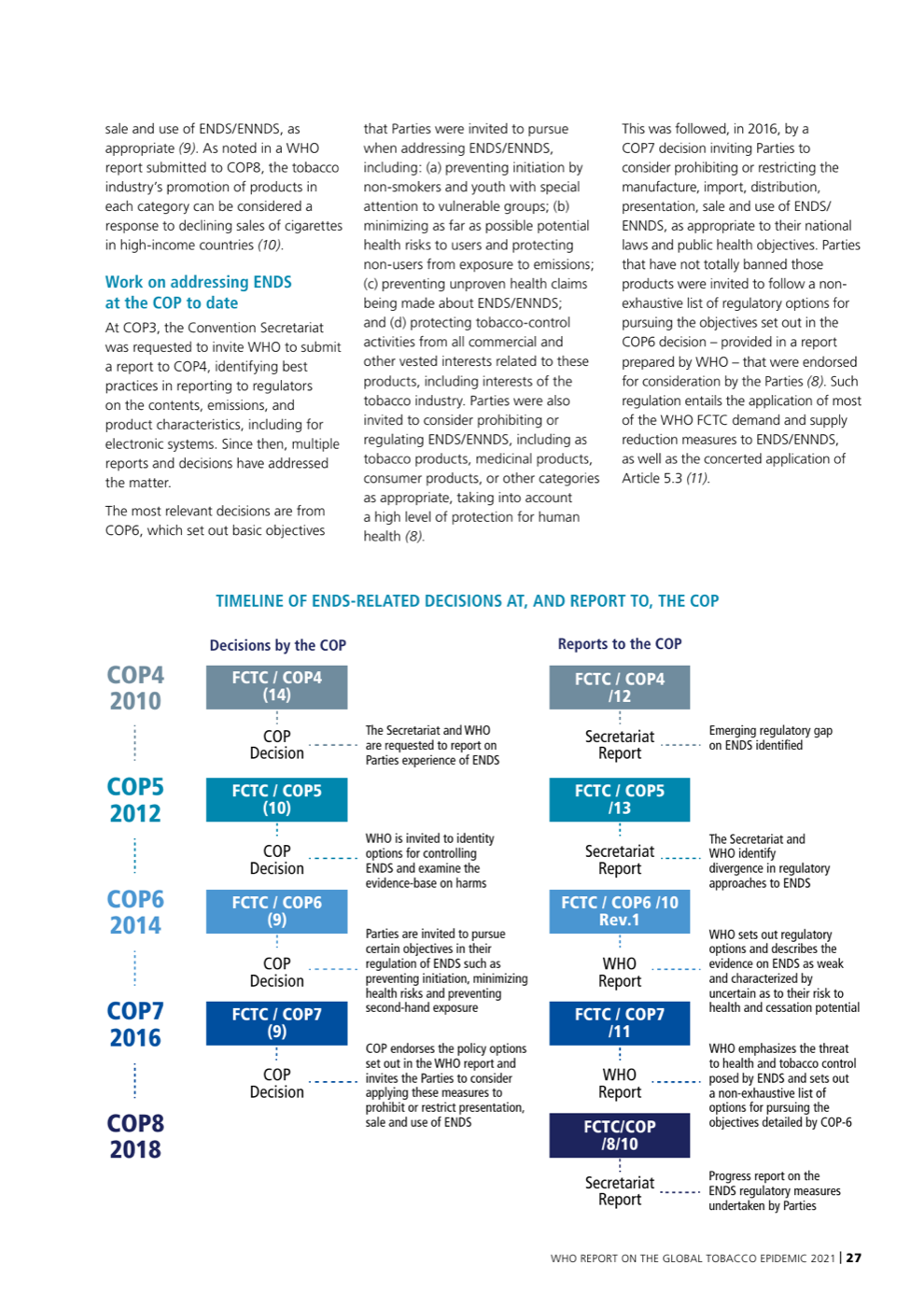
Timeline of ENDS-related decisions at, and reports to, the COP — from COP4 (2010) through COP8 (2018).
Work on addressing HTPs at the COP to date
Since their emergence, HTPs have been marketed with health and cessation claims that are not supported by independent, solid evidence. Cessation is defined in the Guidelines for implementation of Article 14 of the WHO FCTC as “the process of stopping the use of any tobacco product…”, and it is therefore implausible to claim this may be done by switching to another tobacco product. In 2016, COP7 requested the Convention Secretariat to invite WHO to report on specific questions related to HTPs at the subsequent session.
Following this report, in 2018 COP8 defined HTPs as tobacco products, “therefore subject to the provisions of the WHO FCTC”. Parties were invited to prioritise certain measures in addressing the challenges posed by novel and emerging tobacco products such as HTPs, and the devices designed for consuming them. Such measures include:
- preventing initiation into the use of novel and emerging tobacco products;
- protecting people from exposure to their emissions and explicitly extending the scope of smoke-free legislation to these products in accordance with Article 8;
- preventing health claims from being made about these products;
- applying measures regarding the advertising, promotion and sponsorship of these products in accordance with Article 13;
- regulating the contents and the disclosure of the contents of these products in accordance with Articles 9 and 10;
- protecting tobacco-control policies and activities from all commercial and other vested interests related to these products, including interests of the tobacco industry, in accordance with Article 5.3;
- regulating — including restriction or prohibition, as appropriate — the manufacture, import, distribution, presentation, sale and use of these products, as appropriate to national law; and
- applying, where appropriate, the above measures to the devices designed for consuming such products.
In 2018, the Convention Secretariat, WHO, and the WHO Tobacco Laboratory Network were also invited by the COP to report on various characteristics of novel and emerging tobacco products, in particular HTPs, and to monitor market developments and the use of these products. Despite HTPs unambiguously being tobacco products, some of their product characteristics pose regulatory challenges for their definition and classification, as well as for the comprehensive application of the WHO FCTC. For that reason, the COP requested the Convention Secretariat and invited WHO to provide more information on novel tobacco products, in particular HTPs, to COP9.
Contextualising the WHO Report on the Global Tobacco Epidemic, 2021
The focus of this report — addressing new and emerging products — is important at a time when the tobacco industry is using new strategies to position itself as a development partner. The foundation for the regulation of ENDS and HTPs, laid down by the COP, has been crucial for translating technical recommendations into political action at the national level.
The documents analysed in this chapter are the political decisions made by Parties to the WHO FCTC in relation to the regulation of ENDS and HTPs. Until solid and independent science presents a different scenario for the consideration of the Parties, these provide the regulatory options that Parties to the WHO FCTC are invited to follow. They are markers of global sentiment capable of cutting through the commercially interested noise and tobacco industry obfuscation that surrounds these products. Such decisions are influential in national regulation and can also contain legally authoritative interpretations of the WHO FCTC’s provisions.