World Conference on Tobacco Control — release of the 2025 WHO Report on the Global Tobacco Epidemic
The 2025 edition of the WHO Report on the Global Tobacco Epidemic was released at the World Conference on Tobacco Control in Dublin. Juliette co-authored the Report’s chapter on the WHO Framework Convention on Tobacco Control and the Protocol to Eliminate Illicit Trade in Tobacco Products. Alongside the Report launch, she contributed to three of the conference’s sessions.
Stopping Tobacco Industry Tactics and its Interference in Policy Making — 25 June
This session aimed to reveal how current systems safeguard industry interests and to collaboratively develop regulatory, legal and public accountability strategies. Juliette spoke in the opening scene-setting discussion and moderated the Making the industry liable breakout.
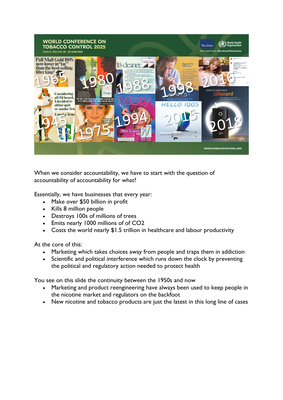
The breakout’s guiding question was: What are the industry’s evolving tactics in hooking youth and how these strategies manipulate public perception? The discussion explored this through different forms of liability — product liability, public nuisance, consumer protection, human rights and environmental frameworks — and how each can be used to shift cost and accountability back to the actors responsible for the harm. Juliette’s speaking points reframed accountability around the structural features of the industry’s business model: that tobacco companies continue to make over $50 billion in annual profit, kill eight million people a year, destroy hundreds of millions of trees, emit close to one-tenth of a billion tonnes of CO₂, and impose an estimated $1.5 trillion cost on healthcare and labour productivity each year. She argued that this continuity is a function of three reinforcing patterns — marketing that takes choices away from people and traps them in addiction; scientific and political interference that runs down the clock on regulatory action needed to protect health; and the re-engineering of the industry’s products and portfolio to keep people hooked in the face of regulation, now extending into nicotine and non-nicotine pouches and products that are the latest in a long line of cases where claims of harm reduction mask continued dependence and harm. The breakout’s framing was that liability across its many forms is one of the most direct routes to aligning the cost of these practices with those producing them.
Using Artificial Intelligence to Advance Forward-Looking Tobacco Control Measures — 23 June symposium
Juliette helped organise this session, part of the 23 June symposium on Addressing Tobacco Control Challenges and Future-Proofing Tobacco Control. The session explored AI’s potential to optimise how information is gathered, analysed and disseminated in support of tobacco control — from data mining and machine learning to chatbot technologies — and brought together perspectives from countries, intergovernmental organisations, NGOs and academia on new AI tools and best practice in areas including monitoring, research, dissemination and cessation support.
Juliette’s intervention reframed the discussion by placing it within the broader commercialisation of the knowledge environment. The session had surfaced AI’s transformative potential for tobacco control alongside the risks of unregulated large language models and the possibility that AI could superpower the industry’s marketing and political interference through the shaping of training data and algorithms. Juliette noted that this risk is real — the tobacco industry’s marketing budgets already outweigh public health spending many times over — but argued that the more fundamental threat extends beyond biased information to the underlying frameworks through which evidence, risk and policy trade-offs are evaluated. As AI systems increasingly mediate how people access information and understand evidence, there is a risk of losing public stewardship over reasoning itself: AI systems that embed industry-friendly evidence standards, risk framings and policy reasoning can make industry perspectives appear natural and neutral rather than contested. She illustrated this with the tobacco industry’s sophisticated attempts to distort meta-regulation instruments — for example its influence over the European Union’s Better Regulation agenda — and asked whether the public sector retains the power to steward how the community collectively considers and creates health evidence and policy. She framed this as one facet of the defining challenge of regulating large technology businesses, and closed by inviting the panel to consider how the tobacco control and public health community can make itself part of that broader effort, and what its role in shaping AI for health might be.
Unmasking Tobacco Harms: Why Liability is Essential
Juliette supported the preparation and research underpinning this session, which she did not deliver herself. The session made the case that liability is central to exposing the full scale of tobacco harms — health, environmental, economic and social — and to returning the cost of those harms to the actors responsible for producing them.